Permafrost
Frozen ground that stores carbon and threatens infrastructure when thawed.

NASA's Scientific Visualization Studio - KBR Wyle Services, LLC/Kathryn Mersmann · Public domain
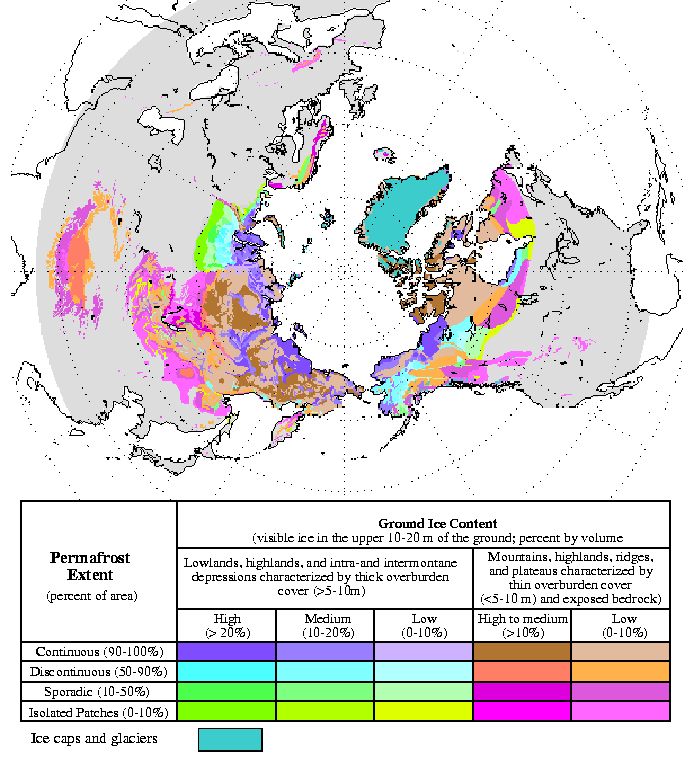
It underlies about 15% of the exposed land surface of the Northern Hemisphere and 11% of the global land surface, covering approximately 18 million km², and is found in large areas of Alaska, Canada, Greenland, Siberia, and high mountain regions such as the Tibetan Plateau. Permafrost is significant because it stores vast amounts of dead biomass, acting as a carbon sink, and its thaw due to global warming releases greenhouse gases, creating a climate change feedback that impacts global carbon budgets.
- definition
- Soil or sediment frozen for two or more consecutive years
- global_land_coverage
- ~11%
- northern_hemisphere_land_coverage
- ~15%
- total_area
- ~18 million km²
- deepest_permafrost_depth
- >1,500 m
- shallowest_permafrost_depth
- <1 m
Lore & Background
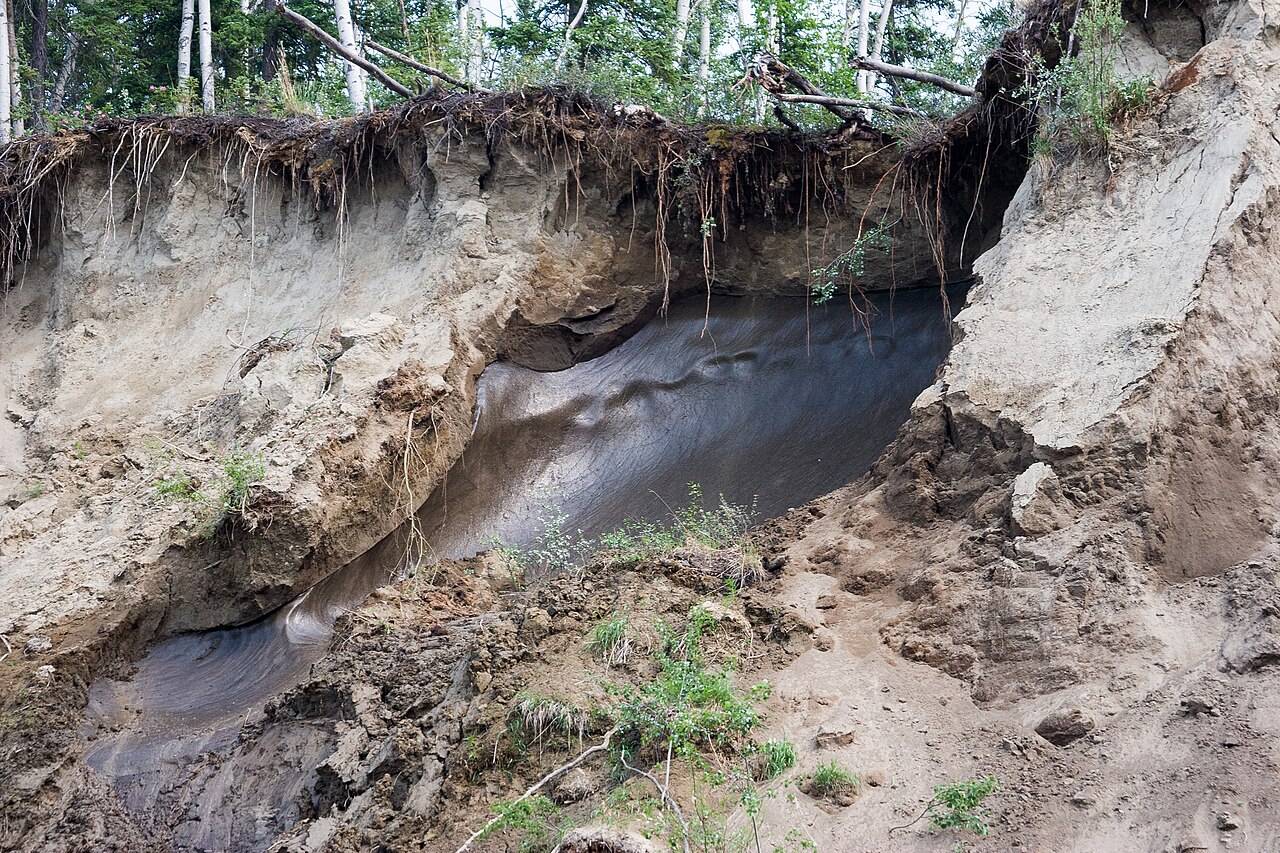
Permafrost forms in climates where the mean annual air temperature is below the freezing point of water, though exceptions occur in humid boreal forests where snow insulates the ground. It typically lies beneath an active layer of soil that freezes and thaws seasonally, with the active layer thickness varying widely across regions. The deepest permafrost can exceed 1,500 m, and its continuity varies from continuous (covering 90–100% of land) to discontinuous (50–90%), sporadic (10–50%), and isolated patches (less than 10%).
Reader's Guide
Permafrost is a critical component of the Earth's cryosphere and climate system. Its role as a carbon sink means that thawing due to global warming releases greenhouse gases, amplifying climate change in a feedback loop. The uncertainty in predicting the amount and form of these emissions (carbon dioxide vs. methane) complicates climate modeling and carbon budget planning. Beyond climate, permafrost thaw threatens human infrastructure—buildings, roads, pipelines—built on previously stable frozen ground, with potential costs reaching tens of billions of dollars by the second half of the century. Additionally, the release of toxic waste and natural mercury from thawing permafrost poses environmental and health risks. While the possibility of ancient pathogens causing pandemics is considered unlikely, the overall significance of permafrost lies in its dual role as a long-term carbon reservoir and a vulnerable foundation for human activity in cold regions.
Did You Know?
- Around 15% of the exposed land surface of the Northern Hemisphere is underlain by permafrost.
- Thawing permafrost can release either carbon dioxide or methane, depending on conditions.
Gallery


Frequently Asked Questions
What is Permafrost?
Permafrost is any soil or sediment that has remained frozen for at least two consecutive years. It ranges from less than a metre deep to over 1,500 metres, making it one of the most variable frozen-ground features on Earth.
Where does Permafrost appear on the map?
It blankets roughly 15 % of exposed Northern Hemisphere land and about 11 % of all global land surface, totalling around 18 million km². Major regions include Alaska, Canada, Greenland, Siberia, and high-elevation zones like the Tibetan Plateau.
What role does Permafrost play in the climate system?
It locks away enormous quantities of dead organic matter, effectively serving as a long-term carbon sink. When warming causes it to thaw, that stored carbon is released as greenhouse gases, feeding a positive feedback loop that accelerates further warming.
How does Permafrost affect human infrastructure?
As it thaws, the ground loses structural integrity, causing roads, pipelines, and buildings in Arctic and sub-Arctic areas to sink, crack, or shift unexpectedly. This makes thaw a major engineering and economic concern for communities built on or near permafrost.
Why is Permafrost considered a key entry in the Geology & Earth Surface series?
It sits at the intersection of cryosphere dynamics, carbon-cycle science, and climate feedback, making it a central case study for how surface geology interacts with global warming. Its sheer area and carbon payload mean even small changes in its stability ripple through the entire Earth system.
More in Geology & Earth Surface 1-23
Spotted an error? Know more?
This is a living reference — every entry is fact-audited, and reader corrections feed straight into our audit queue. Suggest an edit · See this site's audit record