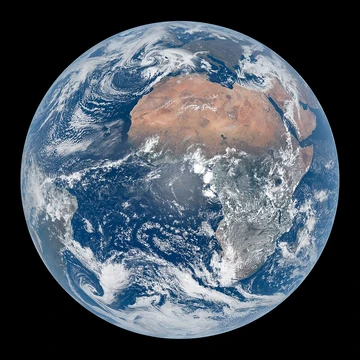
Plate tectonics
Scientific theory of Earth's moving lithospheric plates.

Surachit · CC BY-SA 3.0
Plate tectonics is the scientific theory that Earth's lithosphere comprises a number of large tectonic plates, which have been slowly moving since 3–4 billion years ago. The model builds on the concept of continental drift, developed during the first decades of the 20th century, and came to be accepted by geoscientists after seafloor spreading was validated in the mid- to late 1960s. The processes that result in plates and shape Earth's crust are called tectonics.
- field
- Geology, Geophysics
- known_for
- Theory that Earth's lithosphere is divided into moving tectonic plates
- key_principle
- Lithosphere exists as separate plates riding on the asthenosphere
- plate_motion_range
- 10 to 160 mm per year
- major_plates
- Seven or eight, depending on definition
Lore & Background
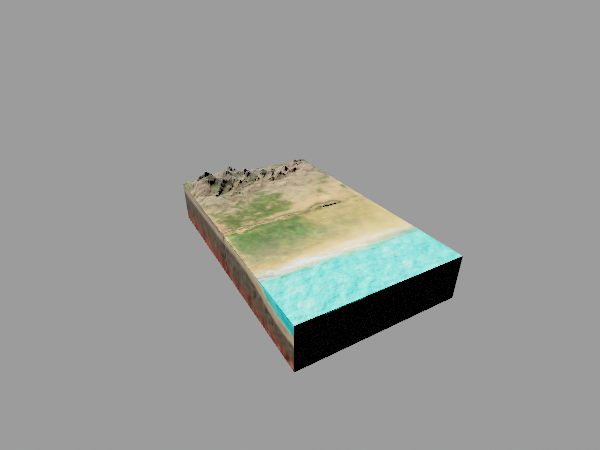
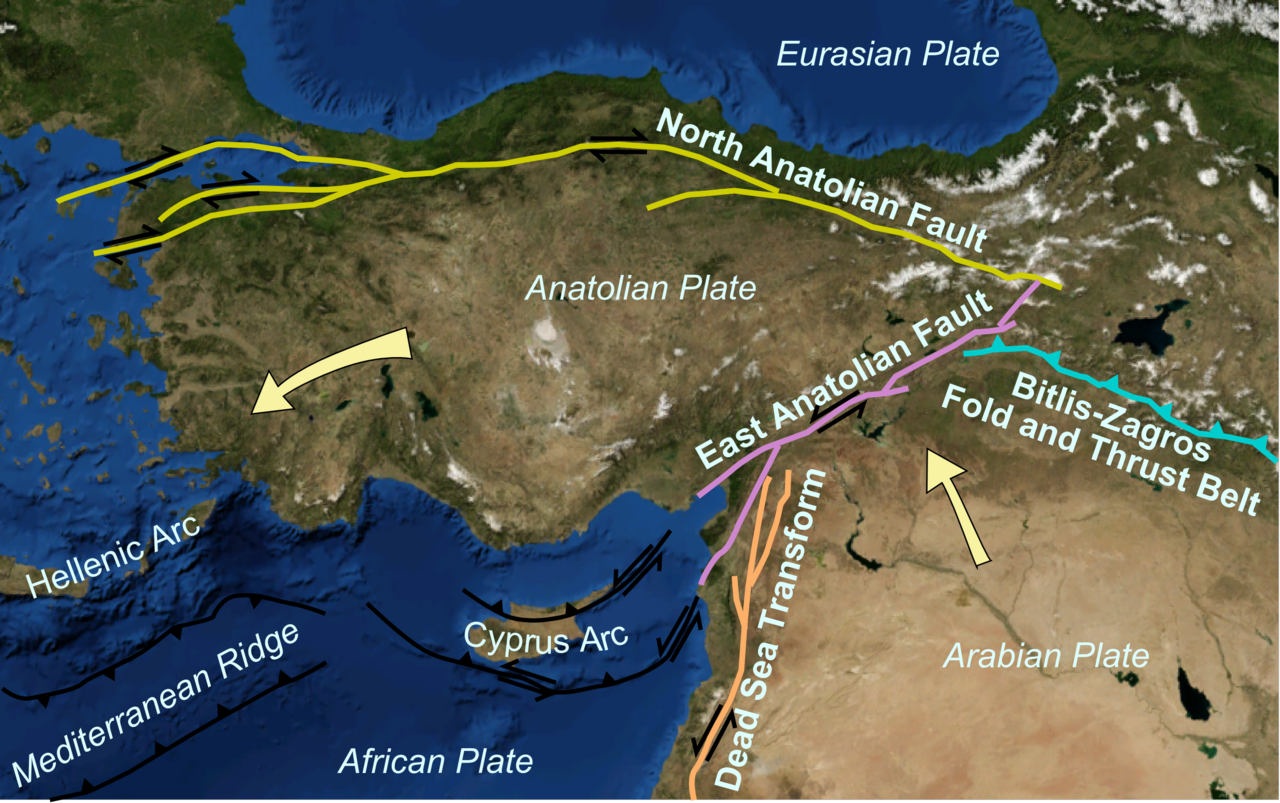
Earth's lithosphere, the rigid outer shell including the crust and upper mantle, is fractured into seven or eight major plates and many minor plates. Where plates meet, their relative motion determines convergent, divergent, or transform boundaries. Faults tend to be geologically active, with earthquakes, volcanic activity, mountain-building, and oceanic trench formation. Tectonic plates are composed of oceanic lithosphere and thicker continental lithosphere, each topped by its own kind of crust. Along convergent boundaries, subduction carries one plate edge under another into the mantle, reducing surface area, balanced by new oceanic crust formation at divergent margins via seafloor spreading.
Reader's Guide
Plate tectonics provides the unifying framework for understanding Earth's surface dynamics, including earthquakes, volcanism, and mountain building. The theory explains the distribution of most active volcanoes along plate boundaries, notably the Pacific Ring of Fire. It also accounts for the formation of oceanic trenches, mid-ocean ridges, and continental collisions. The relative movement of plates, typically zero to 10 cm annually, drives geological activity. While Earth is the only planet known to currently have active plate tectonics, evidence suggests other planets and moons, such as Jupiter's moon Europa, have exhibited similar ice crustal plate movement. The theory's acceptance in the mid- to late 1960s revolutionized geology, linking seafloor spreading, continental drift, and mantle convection into a coherent model.
Did You Know?
- Plate motions range from 10 to 40 mm per year at the Mid-Atlantic Ridge to about 160 mm per year for the Nazca plate.
- Oceanic lithosphere thickness varies from about 6 km at mid-ocean ridges to over 100 km at subduction zones.
- The Pacific plate's Ring of Fire is the most active and widely known volcanic region along plate boundaries.
- Some pieces of oceanic crust, called ophiolites, failed to be subducted and were preserved within continental crust.
The 1960s Revelation and the Architecture of the Lithosphere
In the 1960s, the geological community arrived at a transformative understanding of how our planet's outer shell is organized. The lithosphere — a term encompassing both the crust and the rigid uppermost slice of the upper mantle — was recognized not as a single continuous shell but as a mosaic of discrete tectonic plates. These plates glide across the asthenosphere, which is the plastically deforming yet still solid layer of the upper mantle beneath them. This reframing of Earth's structure became one of the central pillars of modern geology, a discipline whose name derives from the Ancient Greek words for 'earth' and 'study of.' By establishing that the lithosphere is segmented and mobile, the theory gave geologists a coherent framework for interpreting the rock record, the distribution of mountain ranges, and the patterns of seismic activity observed around the globe.
Observational Pillars — Seafloor Spreading, Mountains, and Quakes
The plate tectonics framework did not emerge from a single dramatic observation but from a convergence of independent lines of evidence. Seafloor spreading stands out as one of the most compelling: the systematic creation of new oceanic crust at mid-ocean ridges and its progressive aging as it moves away provided a direct, measurable signature of lithospheric motion. Equally important is the global distribution of mountain terrain, which aligns with the boundaries where plates interact, and the worldwide pattern of seismicity, which traces the zones of greatest mechanical stress between adjacent plates. Together, these observations form a mutually reinforcing body of evidence. Geologists, drawing on fieldwork, geophysical techniques, chemical analysis, and numerical modelling, have used these data to chronicle Earth's geological history as a whole, demonstrating not only the age of the planet but also the evolutionary history of life and the record of past climates preserved in the rock record.
The Convection Engine — How the Mantle Drives the Plates
At the heart of plate tectonics lies a deep mechanical coupling between the rigid plates at Earth's surface and the slow, ductile convection occurring within the mantle below. Heat transfer through the gradual movement of mantle rock generates convection currents, and the oceanic portions of tectonic plates are locked to these currents in a way that ensures they always travel in the same direction. This is not a coincidence of alignment; rather, the oceanic lithosphere functions as the rigid upper thermal boundary layer of the convecting mantle itself. In other words, the plate and the flow beneath it are two expressions of a single thermal system. This coupling — the defining feature that gives plate tectonics its name — explains why the movement of surface plates is not an isolated phenomenon but is intimately tied to the internal heat engine of the planet, linking the solid, plastically deforming asthenosphere to the rigid crust above in one continuous mechanical narrative.
Plate Tectonics Within the Broader Geological Enterprise
Plate tectonics is not an isolated theory but a foundational component of geology as a whole — a branch of natural science concerned with Earth and other astronomical bodies, the rocks composing them, and the processes that reshape those rocks over time. Modern geology overlaps extensively with hydrology, Earth system science, and planetary science, and plate tectonics sits at the intersection of all these fields. It provides the structural context for understanding how igneous, sedimentary, and metamorphic rocks form, transform, and recycle through the rock cycle. In practical terms, the theory underpins mineral and hydrocarbon exploration, the evaluation of water resources, the assessment of natural hazards, and the remediation of environmental problems. Geology, with plate tectonics as a central explanatory framework, remains a major academic discipline and a cornerstone of geological and geotechnical engineering, connecting the deep-time history of the planet to the immediate challenges facing modern society.
Gallery
Frequently Asked Questions
What is Plate tectonics?
Plate tectonics is the overarching geological framework describing how Earth's rigid outer shell (the lithosphere) is broken into large, slowly shifting plates. It unifies earlier ideas like continental drift into a single, testable model of crustal dynamics.
What are Plate tectonics's core mechanics?
The central principle is that discrete lithospheric plates float atop the more ductile asthenosphere, driven by mantle convection and slab pull. There are roughly seven or eight major plates, depending on how boundaries are defined, and they interact at divergent, convergent, and transform margins.
When and why was Plate tectonics finally accepted by the scientific community?
Although continental drift was proposed in the early 1900s, the theory gained broad consensus only after seafloor spreading was confirmed in the mid- to late 1960s. That validation gave geoscientists the missing evidence linking seafloor age patterns to plate motion.
How fast do the tectonic plates actually move?
Plate velocities range from about 10 mm per year for the slowest plates up to roughly 160 mm per year for the fastest. Over hundreds of millions of years, those modest rates are enough to open oceans, build mountain ranges, and reconfigure entire supercontinents.
Why does Plate tectonics matter to Earth's surface and life?
It is the master process behind earthquakes, volcanic arcs, mountain-building, and the long-term recycling of crustal material. Without plate motion, the planet's surface chemistry, climate feedbacks, and habitable environments would look radically different.
More in Geology & Earth Surface 1-23
Spotted an error? Know more?
This is a living reference — every entry is fact-audited, and reader corrections feed straight into our audit queue. Suggest an edit · See this site's audit record